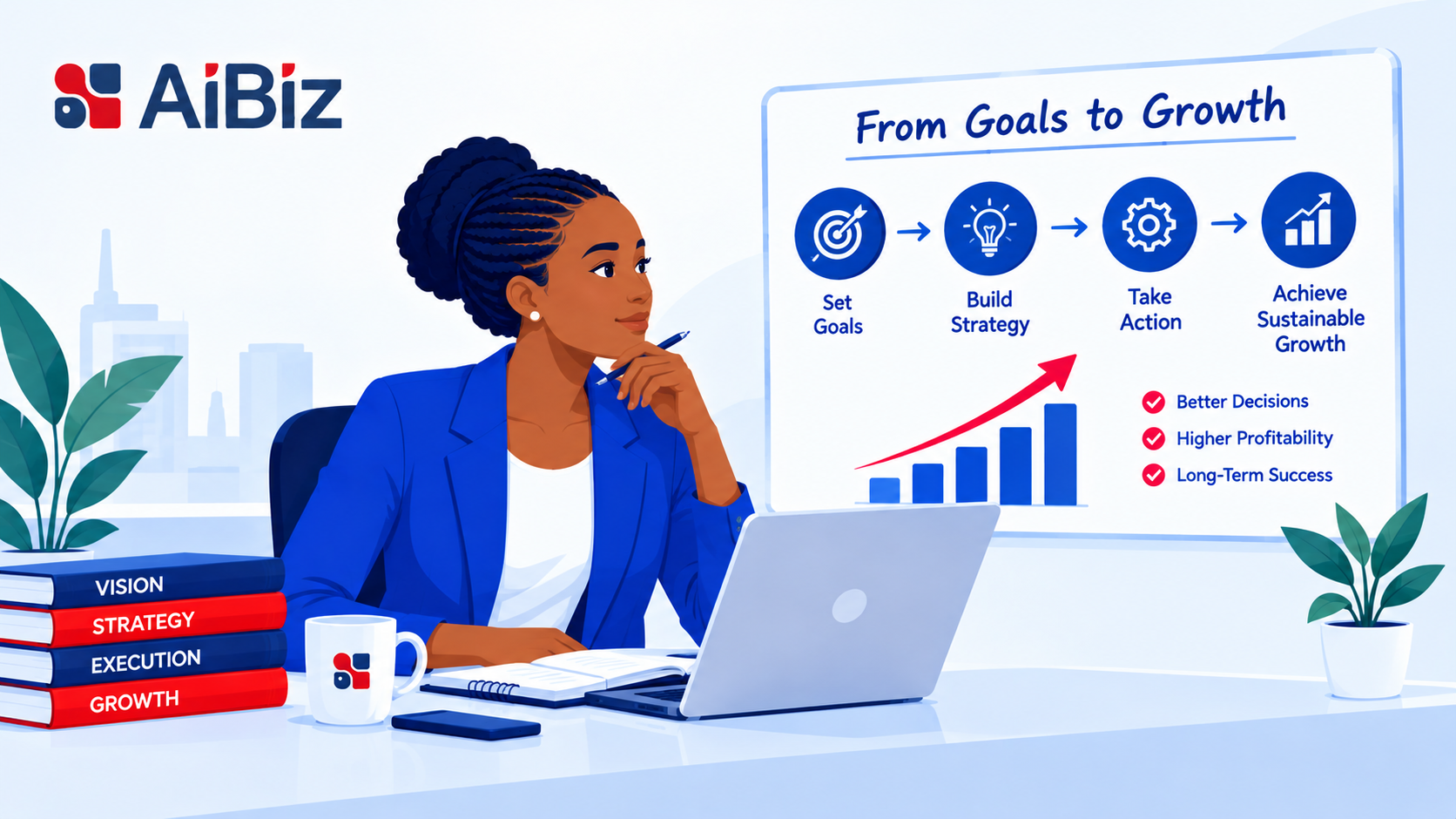
Business survival is not just about making profits today; it is about knowing where you want the business to be tomorrow and having a clear plan to get there. Strategic thinking helps businesses move beyond short-term decisions by providing direction, measurable goals, and practical strategies for sustainable growth. In this article, we explore how vision, mission, strategy, measurement, and effective controls can help businesses turn their ambitions into purposeful action.
Businesses fail not necessarily because of harsh economic conditions, but often because of a lack of strategic thinking. For many businesses, the immediate goal is to make enough profit to survive, pay employees, and keep operations running. However, not enough attention is given to what the business should look like in the future and how it intends to get there.
The roadside retailer, for example, may be primarily concerned with making enough sales each day to replenish her stock and continue trading. While this is important, strategic thinking requires looking beyond today's sales to consider questions such as: How can I grow this business? How can I serve more customers? Can I open another outlet? What changes in my market could affect my business in the next few years?
There are often claims that a significant proportion of small businesses fail within their first few years of operation. While failure rates vary by country, industry, and definition of failure, the broader lesson remains relevant: businesses need to continuously evaluate their strategies and adapt to changing economic and competitive conditions.
Strategic thinking is simply an intentional and rational thought process that focuses on analyzing the critical factors and variables that can influence the long-term success of a business, team, or individual. Businesses operate in a competitive landscape where new trends emerge quickly. They must identify opportunities, manage threats, understand changing customer needs, and make informed decisions to remain sustainable and profitable.
Strategic Thinking Begins with Vision and Mission
Strategic thinking is not something that should only happen when a business is facing a problem. It should be embedded in the business from its formation and practiced at every level of the Organization.
It begins with establishing a clear vision and mission statement. These two terms are often interchanged, although they serve different purposes.
A vision statement describes the future state an organization wants to achieve. It is aspirational, long-term, and provides direction for growth.
A mission statement, on the other hand, defines why the company exists, what it does, who it serves, and how it creates value. It is more focused on the present and guides the organization's daily decisions and operations.
Having a vision and mission statement, however, is not enough. The real question is whether the business is actually thinking strategically.
Let us consider two companies, A and B, operating in the same manufacturing industry:
Company A
Vision: To become the most profitable manufacturing company in the market.
Mission: To manufacture and sell products that generate profit for the company.
Company B
Vision: To become a leading manufacturer known for innovative, sustainable, and accessible products that improve everyday life.
Mission: To create high-quality products that meet evolving customer needs while investing in people, innovation, operational excellence, and sustainable business practices.
Both companies want to make profits, but their statements demonstrate different approaches to the future. Company A is primarily centered on an outcome (profitability) while Company B establishes a broader direction that can guide decisions around customers, innovation, people, operations, and sustainability.
The exercise is not necessarily about deciding which company will succeed. Rather, it demonstrates an important principle: a business needs a clear sense of direction before it can develop effective strategies to reach its desired destination.
From Vision to Strategy
Another important aspect of strategic thinking is putting strategies in place. Strategies are the approaches an organization uses to fulfil its mission and move towards its vision. Although an organization may have one vision and one mission statement, it can have several strategies supporting them.
For example, a manufacturing company whose vision is to become a market leader may develop strategies around product innovation, market expansion, customer retention, cost efficiency, technology adoption, and employee development.
However, having strategies is not enough. A strategy that cannot be measured is difficult to manage.
Businesses should therefore translate broad strategies into specific and measurable objectives. Instead of simply stating, "We want to increase our market share", the business could set a target such as "Increase market share by 10% within the next three years."This creates a clear basis for measuring progress.
Key Performance Indicators (KPIs), budgets, timelines, milestones, and performance targets can help management determine whether a strategy is producing the desired results. What gets measured can be monitored, reviewed, and improved.
Strategy Requires Systems and Controls
Even the most carefully designed strategy can fail if there are no systems to support its implementation.
Businesses need appropriate controls, processes, responsibilities, and reporting systems to ensure that strategies move from paper into action. Employees should understand their roles, resources should be allocated appropriately, and management should regularly review performance against established targets.
For instance, if a company's strategy is to reduce production costs, it may need systems for monitoring procurement costs, inventory levels, production efficiency, wastage, and supplier performance. If its strategy is to improve customer satisfaction, it may need systems for collecting customer feedback, resolving complaints, and monitoring service quality.
These systems also provide an opportunity to identify when a strategy is no longer producing the expected results. Strategic thinking is not about rigidly following a plan; it involves reviewing assumptions, responding to changes, and making necessary adjustments while remaining aligned with the organization's vision and mission.
Think Beyond What Is Possible Today
Strategic thinking requires businesses to look beyond their immediate circumstances and consider what they can become. A difficult economy, limited resources, or intense competition may create genuine constraints, but they should not automatically determine the limits of a business's ambition.
Businesses should not limit themselves through their thinking. Instead, they should clearly define where they want to go, develop practical strategies for getting there, establish measurable objectives, and put the right systems and controls in place to monitor execution.
Ultimately, sustainable growth does not happen by chance. It requires businesses to think ahead, plan effectively, execute deliberately, and continuously adapt their strategies towards achieving their stated goals and objectives.